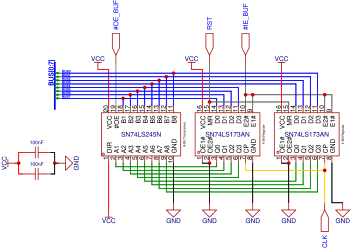
Buffer-Register
The Buffer-Register is built in the same way as the A-Register, but due to convention, it’s not used as a general-purpose register. Instead, it is used when fetching an address operand from the memory if an opcode requires it.
The problem is that the address is saved in two different bytes that have to be transferred from the memory output to the Memory-Address-Register in two steps (The address is stored in little-endian format, so the low byte is stored first, followed by the high byte).
If you transferred the first byte of the address directly to MAR_L, this byte would be lost when the high byte is fetched in the following step and the program counter is loaded into the Memory-Address-Register once again. The solution is to store the low byte in the Buffer-Register first, and only load it into MAR_L after the high byte was fetched and transferred to MAR_H. In the end, the address is correctly placed in MAR for it’s corresponding memory access.
Schematic